

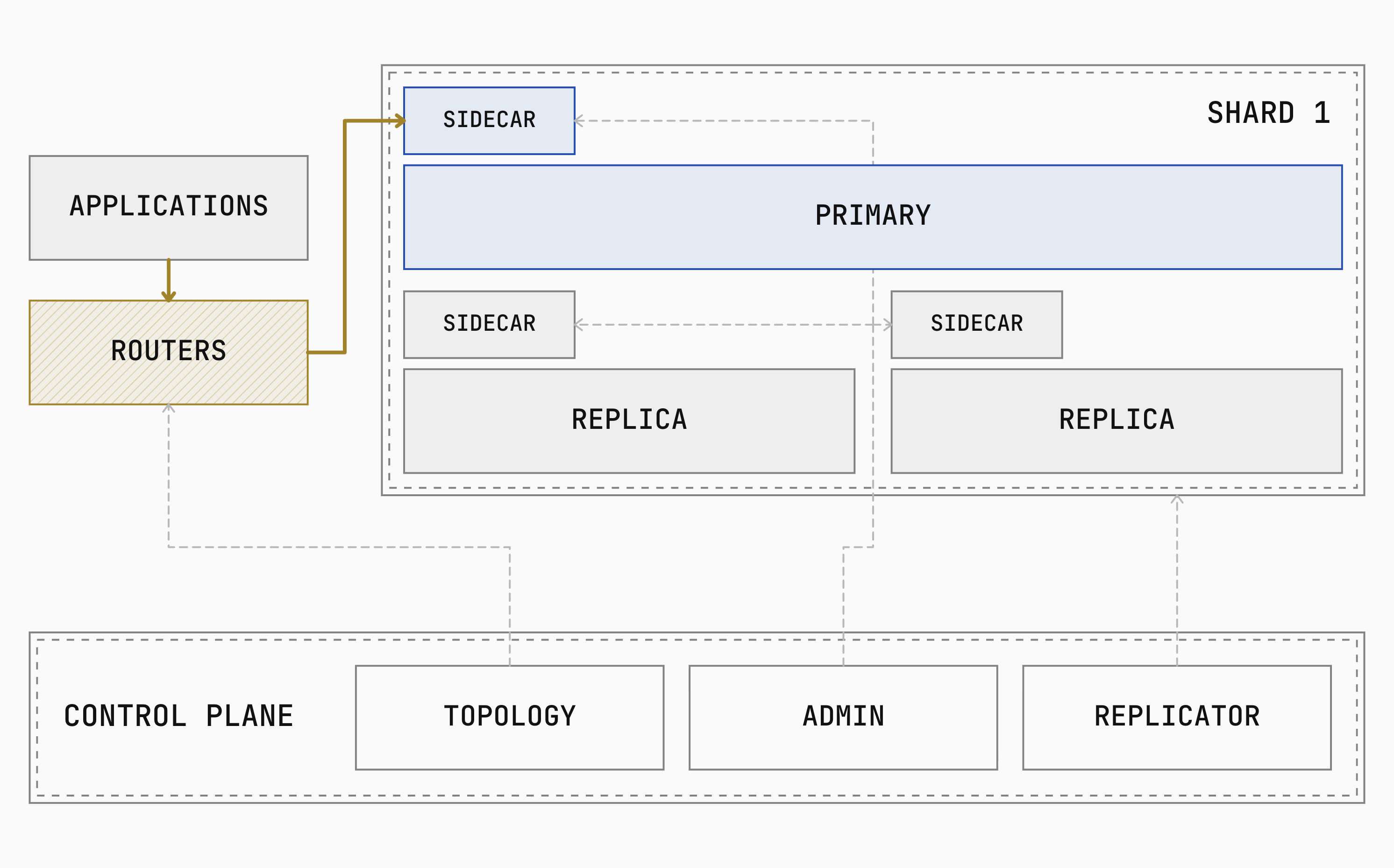
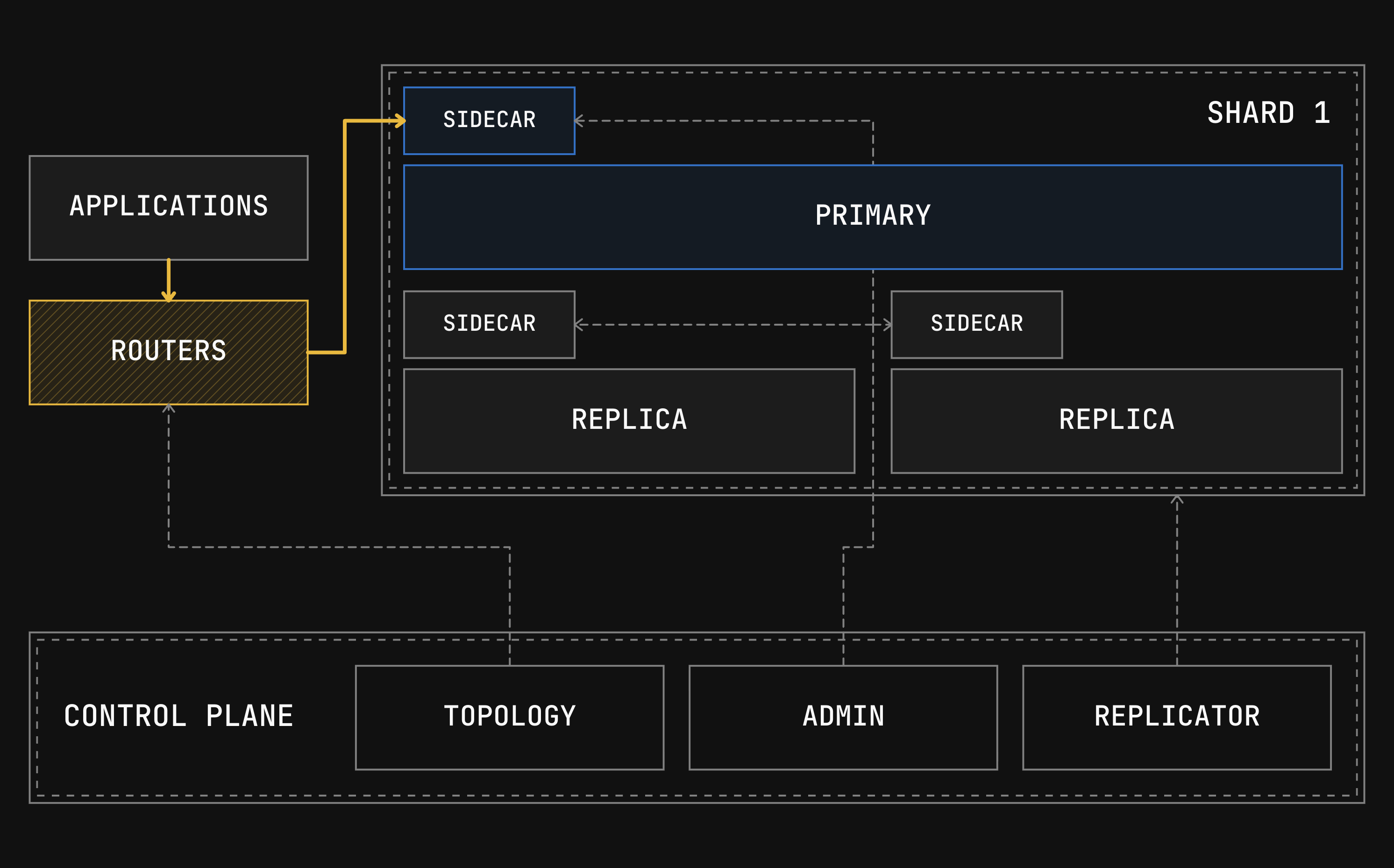
Routers
A router is the Neki service that accepts Postgres connections and decides which shard or shards should run each statement. It uses the data topology and table definitions to build plans for and route incoming queries. When a query touches multiple shards, the router can combine their results before returning one result to the client. Applications connect through the Postgres wire protocol, so they can continue to use standard Postgres clients and ORMs. See Query planning for how Neki builds and reuses query plans. Routers are stateless, in that they are not responsible for durably storing information about the cluster, data topology, or database schema. The data topology and database schema are stored elsewhere, and locally cached and kept in sync on all routers. Because of this, routers can be easily scaled both vertically and horizontally to meet traffic demands. A single Neki cluster can have anywhere from one router to hundreds of routers. Learn more about how to manage routers in our cluster configuration documentation. There is no primary router and no leader election. Any router can serve any connection. If a router fails, the connections it was holding at the time are dropped. To a client, this looks like any other lost Postgres connection, and it can reconnect to a different router node. This lends Neki to being highly-available by default. Every Neki cluster on PlanetScale comes with a minimum of 3 routers spread across three availability zones.What runs alongside Postgres
A shard consists of one Postgres primary and its replicas. Each shard is its own failure domain. It handles switchovers and failovers independently from any other shard in the cluster. Every Postgres instance within a shard has two Neki components running alongside it: a Sidecar and a PostgresManager. The Sidecar is the per-instance endpoint for router queries and admin operations. All communication from a Neki Router to a Postgres node happens via a sidecar. The Neki admin service also queries it during health checks. Each sidecar streams its serving status to the routers, which use the latest status when selecting an instance. The PostgresManager manages the startup, teardown, and data directory of it’s attached Postgres instance. When a replica promotion happens due to a planned switchover, the sidecar and PostgresManager on each instance keep running throughout.The control plane
The control plane stores topology, monitors managed shards, repairs failures, and runs workflows that move data.The admin
Admin is a service that manages the health of all other components of the Neki cluster. For Neki-managed shards, it health-checks each Postgres instance through that instance’s sidecar and acts on what it finds. More than one admin can run at once. One of them holds recovery leadership, and only the leader performs node repairs. One of Admin’s main roles is handling planned switchover and unexpected failovers within the Postgres primary and replicas within a shard. An unplanned failover replaces a primary that is no longer available. This could be due to a Postgres-level software crash, or the failure of underlying hardware. When choosing a replica to replace the primary with, Neki checks how much write-ahead log (WAL) each reachable replica has received. It prefers a replica that has already replayed all available WAL and waits briefly for one to catch up if needed. If none is ready, Neki promotes the replica that has received the most WAL. When using synchronous or semi-sync durability, there should always be at least one replica candidate with a fully caught up LSN. After promotion, Neki points the other replicas at the new primary. If it cannot update a replica, a later health check finds and repairs it. A planned switchover moves the primary role while the old primary is still healthy. Neki does this before maintenance on the primary, before taking that node out of service, or during a Neki rolling upgrade. Neki makes the old primary read-only and waits for the selected replica to catch up before promoting it. A completed switchover preserves the commits made on the old primary. If the switchover fails before promotion, Neki makes the old primary writable again. A durability policy decides whether the primary waits for a replica before confirming a commit. New shards start withsync as their configured policy.
With sync, the primary normally waits for one replica to receive the write.