> ## Documentation Index
> Fetch the complete documentation index at: https://planetscale.com/docs/llms.txt
> Use this file to discover all available pages before exploring further.
# Deploy to Vercel
> This guide will walk you through setting up and deploying your PlanetScale database on Vercel.
To use a PlanetScale database with Vercel, there are a few prerequisites:
* A PlanetScale database — If you haven't created a database, refer to our [PlanetScale quickstart guide](/vitess/tutorials/planetscale-quick-start-guide) to get started
* A [Vercel account](https://vercel.com/)
* A project deployed to Vercel — If you're just poking around and don't already have an application to deploy, you can use our [Next.js + PlanetScale sample](/vitess/tutorials/connect-nextjs-app)
## Get your connection string from PlanetScale
In your [PlanetScale dashboard](https://app.planetscale.com), click on the database you want to connect to.
Click "**Connect**".
Create a new password. Make sure to copy the password, as you'll only be shown it once.
Select the framework you're using from the "**Select your language or framework**" section. This will give you the exact environment variable names you need for your selected framework. If your framework is not listed, choose "Other".
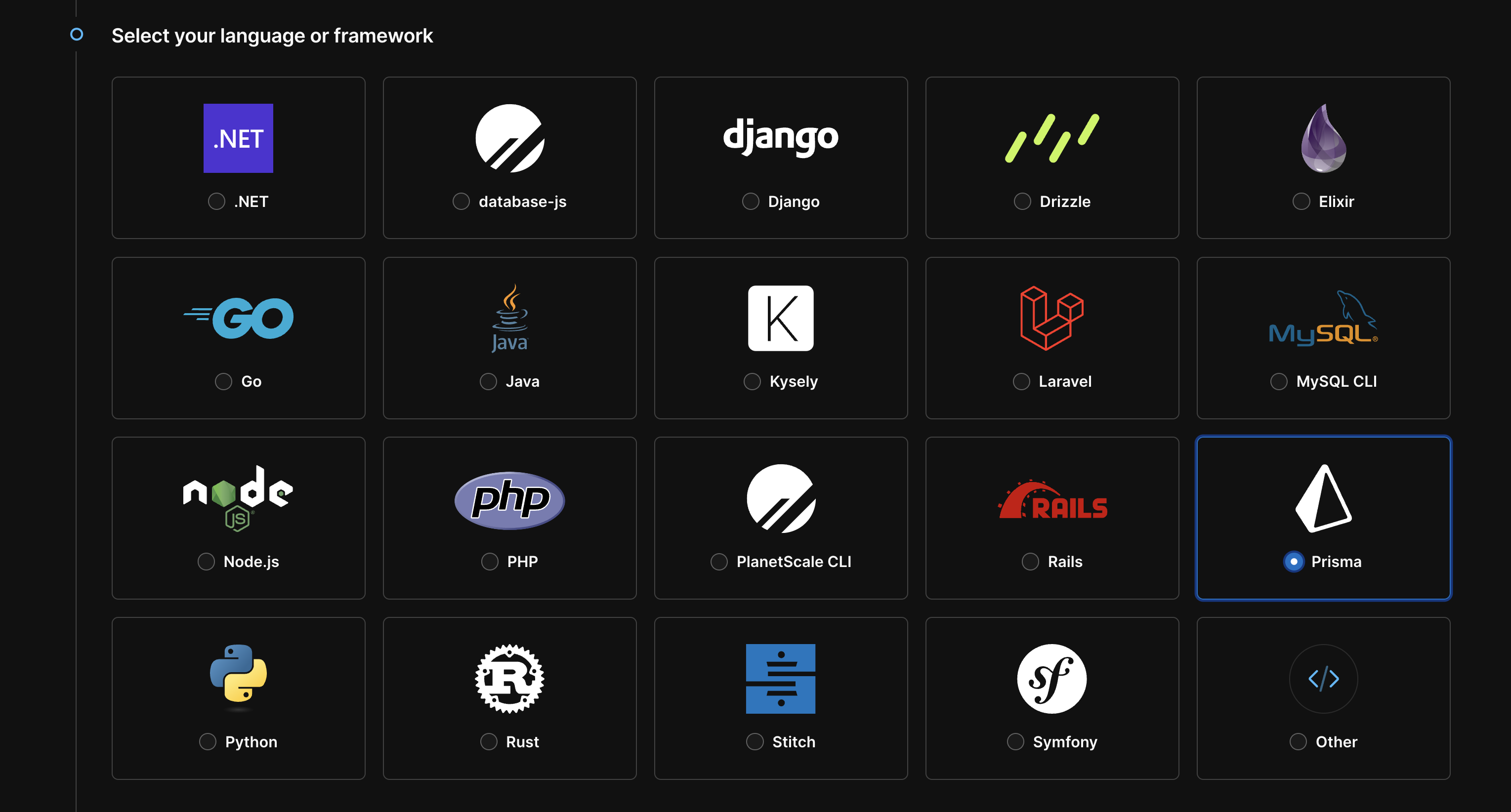 Keep this page open, as you'll need to copy these to Vercel momentarily.
If you navigate away from the page, and can no longer access the password, create a new password by repeating steps 1-5.
## Copy environment variables to Vercel
Go to your Vercel dashboard.
Click on your Vercel project.
Click "**Settings**".
Click "**Environment variables**".
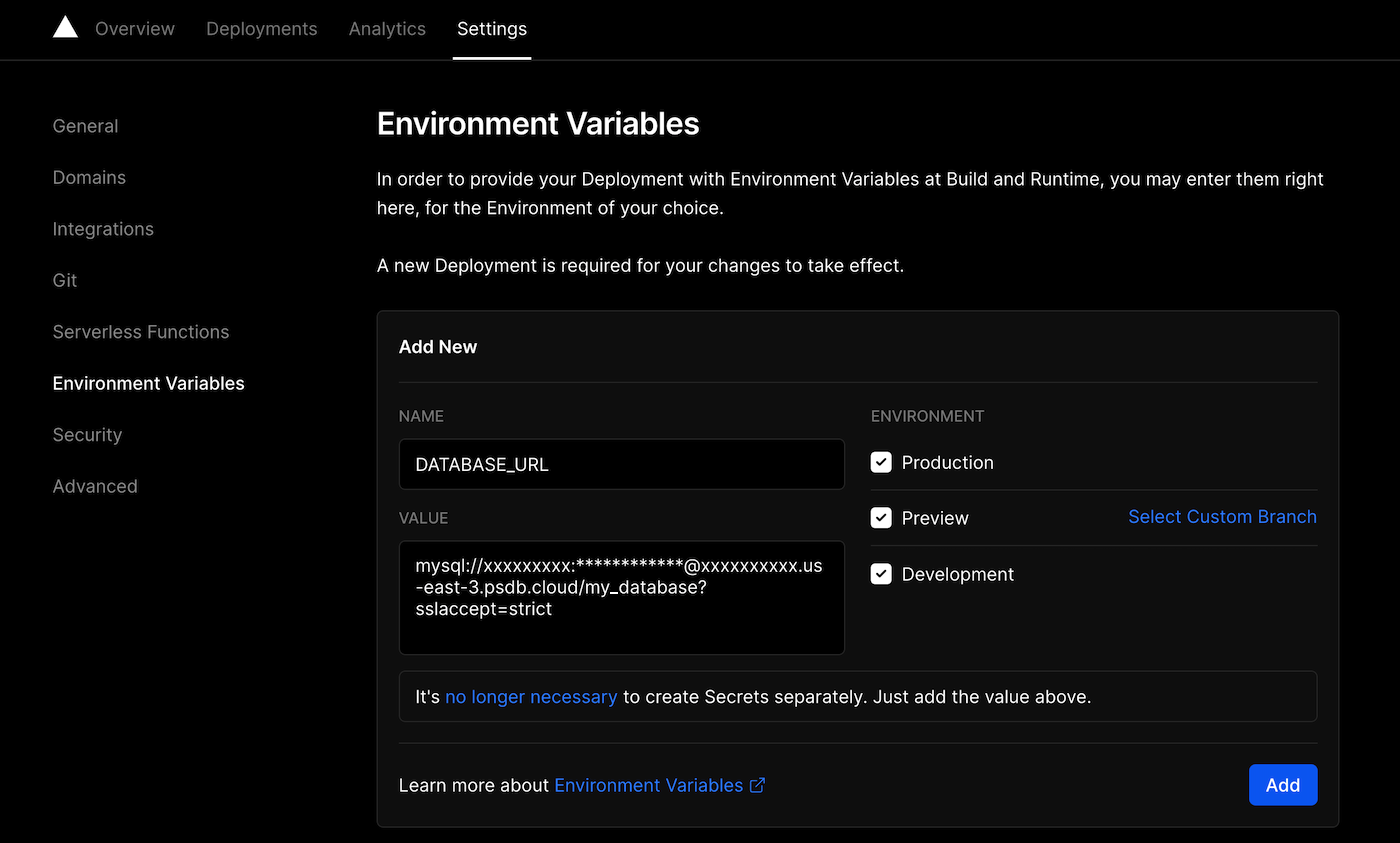
Copy each value from your PlanetScale dashboard into a new environment variable in Vercel. Once you're done with one, click "**Add**" and continue to the next, if applicable.
For example, if you're using Prisma, your connection string will look similar to this:
```bash theme={null}
DATABASE_URL='mysql://xxxxxxxxx:************@xxxxxxxxxx.us-east-3.psdb.cloud/my_database?sslaccept=strict'
```
In Vercel, you'll set it as follows:
* **NAME** = `DATABASE_URL`
* **VALUE** = `mysql://xxxxxxxxx:************@xxxxxxxxxx.us-east-3.psdb.cloud/my_database?sslaccept=strict`
The credentials are blurred for the example, but when you paste them in, use the actual values.
Keep this page open, as you'll need to copy these to Vercel momentarily.
If you navigate away from the page, and can no longer access the password, create a new password by repeating steps 1-5.
## Copy environment variables to Vercel
Go to your Vercel dashboard.
Click on your Vercel project.
Click "**Settings**".
Click "**Environment variables**".
Copy each value from your PlanetScale dashboard into a new environment variable in Vercel. Once you're done with one, click "**Add**" and continue to the next, if applicable.
For example, if you're using Prisma, your connection string will look similar to this:
```bash theme={null}
DATABASE_URL='mysql://xxxxxxxxx:************@xxxxxxxxxx.us-east-3.psdb.cloud/my_database?sslaccept=strict'
```
In Vercel, you'll set it as follows:
* **NAME** = `DATABASE_URL`
* **VALUE** = `mysql://xxxxxxxxx:************@xxxxxxxxxx.us-east-3.psdb.cloud/my_database?sslaccept=strict`
The credentials are blurred for the example, but when you paste them in, use the actual values.
 ## What's next?
Learn more about how PlanetScale allows you to make [non-blocking schema changes](/vitess/schema-changes) to your database tables without locking or causing downtime for production databases.
## Need help?
Get help from [the PlanetScale Support team](https://planetscale.com/contact?initial=support), or join our [Discord community](https://pscale.link/community) to see how others are using PlanetScale.
## What's next?
Learn more about how PlanetScale allows you to make [non-blocking schema changes](/vitess/schema-changes) to your database tables without locking or causing downtime for production databases.
## Need help?
Get help from [the PlanetScale Support team](https://planetscale.com/contact?initial=support), or join our [Discord community](https://pscale.link/community) to see how others are using PlanetScale.